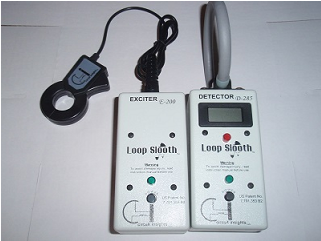


After investing substantial
time and money putting together an electronic instrument system that is supposed to measure an important
signal, what you get is corrupted by a ground loop. Chasing down such a ground loop has traditionally been a frustrating
experience like trying to find a needle in a haystack - you could spend hours or days searching without success.
No longer! The Loop SloothTM (patent pending) enables
quick determination of which cable or cables are involved in a ground loop without disconnecting anything. What
used to take hours or days of frustration now takes minutes!
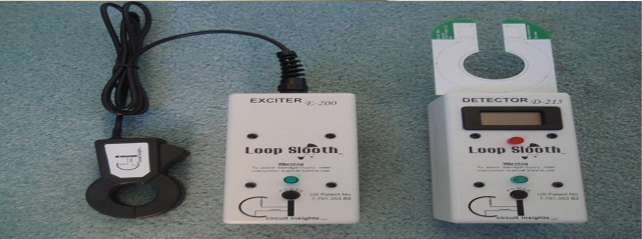
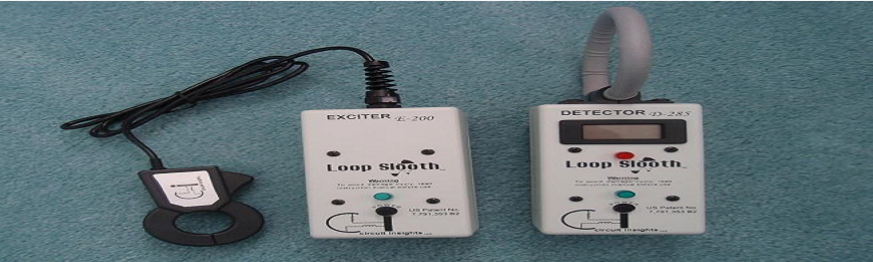
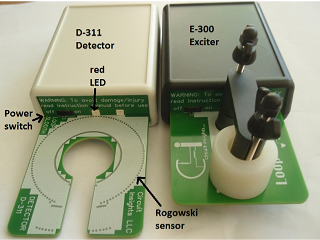
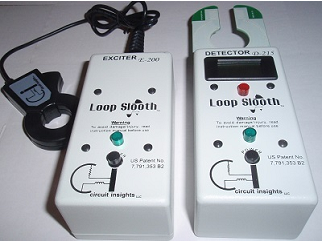
The Loop SloothTM consists of two battery-powered modules, an Exciter and a
Detector. The Exciter uses a proprietary clamp-on transformer to induce a high-frequency current in a ground loop -- if the
loop exists -- while the clamp-on Detector detects the AC magnetic field associated with this current. Because
the Detector is tuned to the same frequency as the Exciter, the Detector responds only to the signal injected by
the Exciter. Scroll through the three photos below to see how the Loop SloothTM is used to find a simple ground
loop.

INSTRUCTION MANUAL
Detailed Technical Reference: P. M. Bellan, Simple system for locating ground loops, Review of Scientific Instruments Volume
78, Article Number 065104 (2007)
| Figure 1 |

|
| |
Figure 1: Which cable is causing a ground loop?
The Loop SloothTM (patent pending) makes it possible to find out fast without disconnecting
anything!
| Figure 2 |

|
Figure 2: First, the Exciter and Detector are both
linked to the power cord of one of the instruments. If the Detector red light illuminates as shown in the figure, the
instrument power cord is part of a ground loop. The Detector meter gives an indication of the severity of the ground loop.